When I was ten, I saw something you might call paranormal. It hadn’t been long since I had moved back to Ohio. I had lived in Florida for a few years when my father was in the Navy. The hills gently rolled, and the cornfields stretched out endlessly. We moved to a small trailer surrounded by a lot of nothing. My bedroom had a sliding glass door that led out to the living room.
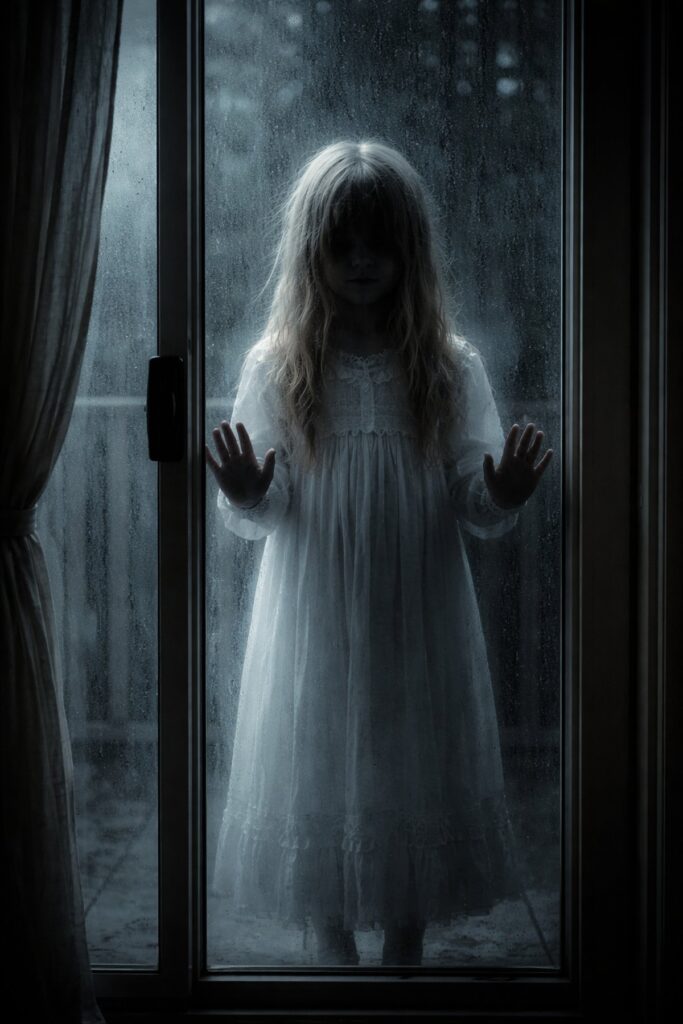
One night while lying in bed, I looked through the door. The lights were still on, meaning my parents were still awake. I saw something odd. I saw a little girl. She had blonde hair and wore an old-fashioned white dress. She was a small child; unsettlingly, her face was shrouded in shadow. I rolled over, scared; something about it felt unnatural. I thought it might just be my younger sister at first. It wasn’t unusual for her to go into my bedroom or my parents’ room to sleep sometimes.
I rationalized it away, thinking it was most likely just her and no big deal. As I rolled over, I looked down on the floor beside my bed and saw my sister, meaning my sister was already there when I saw the girl behind the glass. I remember being really scared, but thinking somehow it was just my little sister and it was no big deal. I don’t think this is true—she couldn’t have gotten there that fast, nor did I see or hear the door open. Also, my sister’s hair was brown and not blonde. I had filed it away and didn’t think about it.
Years later, a friend asked if I had ever seen a ghost, and I said no. I didn’t believe in ghosts. Later that day, I remembered the experience with the little girl, and I was thoroughly freaked out. It didn’t really help when I asked my mother about it. She said something in my memory like “oh yeah, by the way, we used to live down the street from a cemetery.” Needless to say, that didn’t really help.
Out of curiosity, I got the idea, “Hey, if there’s a cemetery, maybe the names would be online,” and I was correct. At the time, we lived on Millers Chapel Road, and I found on the website “Find a Grave” Millers Chapel Cemetery. It is a small burial ground with only fifty-one people listed. On it, I found the name of a little girl. Her name was Eliza Gootherman. She was two years old and died April 28th, 1860
She seemed the best candidate, based on age. I also learned, adding to the creepy factor, that girls who died during that time were often buried in white dresses symbolizing purity. There’s something that struck me about her: how unfair it was that she died before she ever got a chance to live. Nothing left to remember her by, long before cellphones—no pictures of her, and not even a picture of her headstone on Find a Grave. We will circle back to the last point later. I felt compelled to know Eliza’s story. I wanted to know what happened to her, what happened to her family.
I didn’t have much to go off of. Record keeping wasn’t exactly the best back then, and part of me felt like it would just be a ghost hunt (no pun intended). I did, however, have the initials of her parents listed online. They were “A.C. and C. Gootherman.” While I had no idea what their names could be, I had the idea that maybe if I went to the library I might be able to find a cemetery list with names on it. Lo and behold, again I was proven correct. I was able to find her parents, Anderson and Catharine Gootherman. I also learned the heartbreaking detail that in the summer of 1866, Anderson and Catharine lost their 21-year-old daughter Nancy. I saw that her parents both died in 1885—Catharine on February 11th, and Anderson two weeks later on the 25th. I saw two people who lived in the harsh realities of rural 19th-century Ohio, and that after his wife died, Anderson may have grieved himself to death.
Knowing Eliza died in 1860 meant that year was a census year, and upon researching, I learned that the census had something called a mortality schedule. They list deaths and, most importantly, causes of death. I looked at my local library and sadly found nothing. Eventually, on a website called Ancestry, I was able to locate the 1860 mortality schedule. The answer I had searched for was right in front of me: I would know what happened to Eliza. The schedule even zoomed in directly to my county, Highland, and by township. I searched through ten pages of scanned copies. The old-timey cursive handwriting was a bit hard to read. I felt like Indiana Jones deciphering ancient hieroglyphs.
I fastidiously combed through every page, leaving no stone unturned. Despite this… I could not find Eliza on the list. I felt such a powerful compulsion to find out what happened to her. I wanted her to be remembered; I wanted to fix a cruel injustice. Realizing she wasn’t there, the thought of failing—I’m not ashamed to say it almost made me cry. After allowing myself to sulk for a bit, I asked myself, “What would the great detective himself do?” I decided if I can’t know for sure, I can at least figure out what the most likely cause of Eliza’s death is by categorizing deaths of children under ten in the schedule. In doing so, I found that roughly one-third of children that year died of scarlet fever. It was a devastating killer of children in the 19th and 20th centuries. The tragedy is, today it’s completely treatable with the use of antibiotics like penicillin. Something that could’ve stolen this little girl’s life is easily treatable by modern medicine—something that could’ve cured her in just a week.
I also looked up a digitized copy of my local newspaper, the Highland Weekly News. The very first article I saw was a homemade cure for scarlet fever. The article referred to it as a “plague,” saying, “Parents should be very careful about their children when this devouring plague seizes them.” This was from the May 3rd, 1860 edition, the first after Eliza died on April 28th. Again, this doesn’t prove it for sure, but adds context to the fear and suffering it caused people in that time. It adds to my theory at the very least. To add further context, 26,402 people died of scarlet fever in 1860, about 7 percent of all deaths. They were disproportionately children. The mortality rate for children under 5 today is about 1 percent. Sadly, in 1860 it was 20 to 30%. Children dying that young wasn’t uncommon. I may never know how she died, and that hurts. I did my best based on the limited data to come as close as I could.
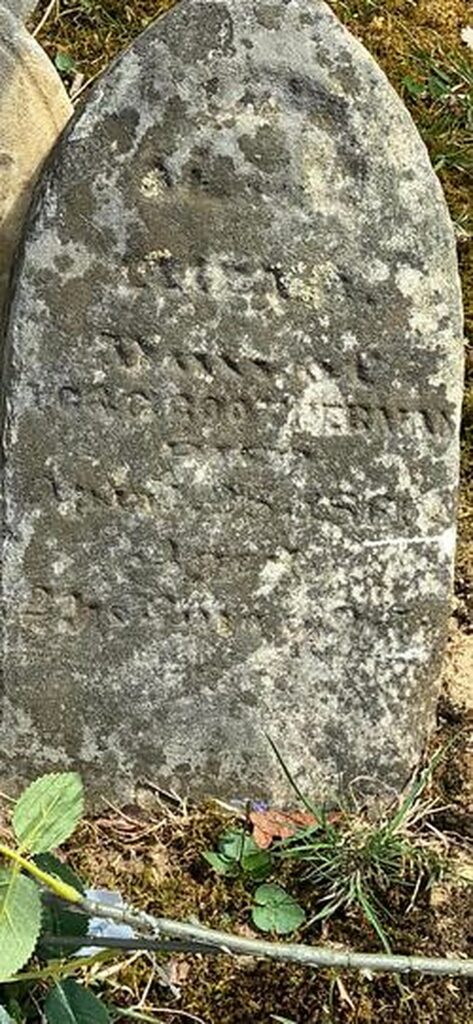
After seeing many pictures of Miller’s Chapel, I decided to make the trip. The church that once stood there had long been gone. The last burial was in 1912; the last newspaper reference was in 1914. No pictures existed that I could find. Walking through the cemetery, I saw many headstones fallen over. Many were broken, like their memories themselves were busted into pieces, slowly dying a second death. I walked towards the back and found the graves of Eliza, her mother Catharine, and her sister Nancy. They were in great shape in comparison to others. I saw a little headstone next to Nancy that I assumed was Eliza’s, but anything written on it appeared eroded by the elements and time. It made me doubt myself and think maybe it was a second headstone for Nancy. I also thought so, given there was no picture of Eliza’s stone on Find a Grave.
I also found something that came as a shock to me. In between Nancy’s headstone and Catharine’s was another stone. This one was positioned directly between the two, as opposed to the smaller one positioned to the right of Nancy’s stone. I walked towards the one in the middle. It was a larger stone, but it had fallen backwards, writing facing upward. Unfortunately, this one was too difficult to read to the point it felt impossible. I managed to make out “ssa.”
At first I had thought it could be Eliza, but the letters didn’t match, and given the fact that she died an infant, the smaller stone was most certainly hers. I took pictures of all the stones and left flowers on their graves. I touched my hand on each tombstone and promised to tell their story. I came to pay my respects, to connect with the family I had gotten to know. I left, however, with more unanswered questions and an even stronger resolve to make their story known. To ensure that they would be remembered.
I used an AI image enhancer called Upscale to examine the stone I strongly suspected might belong to Eliza. The stone was of lesser quality than the other family members. This made reading it no small feat. It didn’t help that I’m no tech wizard, but what I lacked in efficiency I made up for with resolve. I kept playing around with the image enhancer until I saw something that caught my eye. I could make out a name, and I could fairly clearly see it ending with “za” and an “o” after it. That was huge. Eliza ends with “za.” I also know her middle initial was “O.” I could see “Daughter of A.C. and C. Gootherman” and make out “died April 28th, 1860.” There it was—it was indeed her stone. I could eventually make out her full name. I added the picture to Find a Grave.
This still left me with questions. What happened to Eliza’s family after she died? Who was the mysterious fourth grave in between Nancy and Catharine? To explain everything, we have to go back to my library trip and how I uncovered the names of Eliza’s parents, Anderson and Catharine. The story starts there. Through digging into old newspapers, marriage records, and wills, I’m able to build a somewhat accurate timeline. Anderson married Catharine in Hamersville, Ohio, on May 13th, 1841. He was 25 and she 18. They went on to have 12 children and had a 100-acre farm. They had various livestock like horses, cows, sheep, and swine. They mostly grew Indian corn and wheat. Placing them as a solid middle-class family. The farm details I learned from the 1870 agricultural schedule.
They attended Millers Chapel Church, the namesake of the cemetery. It was built in 1840 and named after the family that helped found it, the Millers. The church followed Abner Jones, who created what is today known as the United Church of Christ. There was also a schoolhouse next to it, where, from newspaper reports of grades, I know the Gootherman children went. Their marriage was long and not without trials. In the end, they died two weeks apart, as I mentioned before. In the brutal winter cold of February 1885.
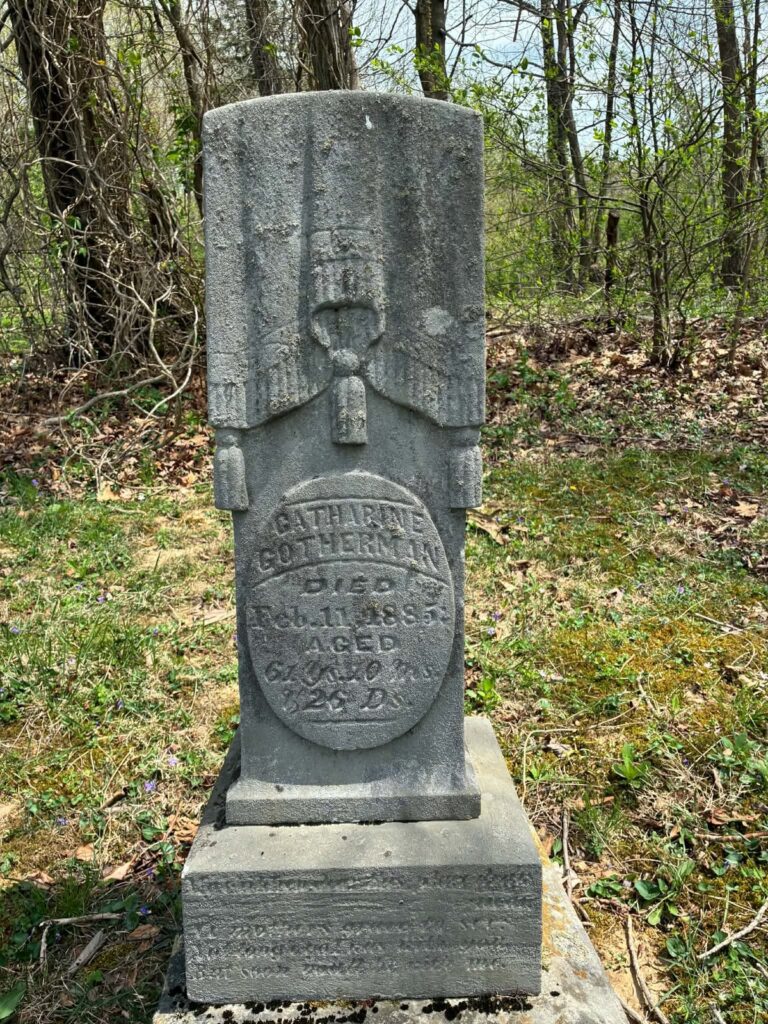
The fact that they died so close really weighed on my heart. I saw a man who had lost his daughters way before their time. Lost his wife of over 40 years, the mother of his twelve children. He grieved himself to death, returning to her in eternity. I looked both of them up on Find a Grave, and upon doing so found something very odd and shocking. Catharine was buried in Miller’s Chapel along with her children, but Anderson was in a totally different cemetery—in Union Cemetery. Why would a husband and wife of 40 years be buried in totally different places? I also noticed a huge difference in the quality of the stones. Catharine’s was made of marble, very ornate, with a double layering. A medallion-style oval with her name carved, perfectly legible over 140 years later. The top had a veil being pulled back, symbolizing going to heaven. On the bottom of the base was a couplet reading: “A mother’s grave for you to see, right now I’m gone, but soon you’ll be with me.”
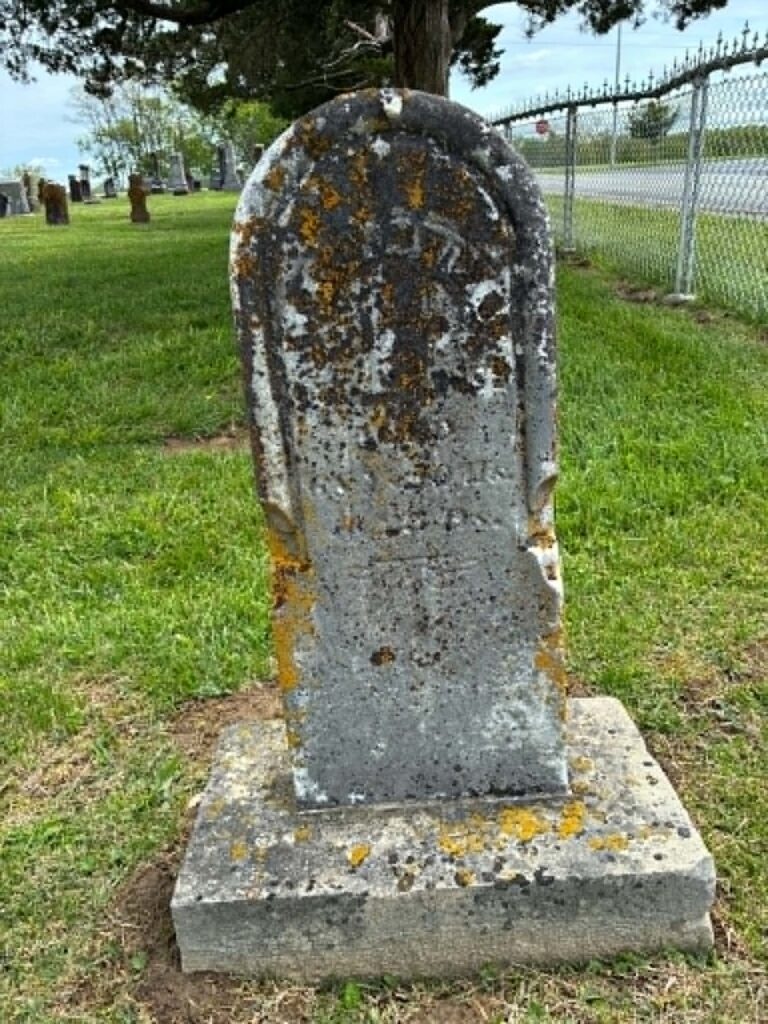
Anderson’s stone was very different. It was made of sandstone, very basic-looking, dressed in moss and lichen. The grey slowly darkened to black, with the name difficult to read. I found myself evaluating the evidence and arrived at a conclusion I hadn’t brought up before. I deduced they were separate in death because they were separated in life, and given the huge social stigma, the event leading to divorce had to be something particularly unpleasant. In those days, no-fault divorce didn’t exist; it had to be on certain grounds, such as abuse, abandonment, or alcoholism. None of those were very nice. So I deduced that the difference in quality of stone may have indicated that the children were closer to their mother—a greater amount of love, thought, and resources were poured into hers.
Even though that was speculative, and even though it went against how I viewed the family, I had this strong intuition that my deduction wasn’t without merit. At the very least, it gave me a testable hypothesis. From there, I concluded the best way to test my theory would be to look at the next census in 1880, since I had already seen the 1870 one and knew they were all together. In doing so, I found Catharine was listed as the head of household, with Anderson not on the list. She was listed with many of her children still living with her. This made me feel like my theory could be true—that indeed they were divorced and my tombstone deduction was right.
I still wanted to be careful, because in theory, if Anderson were traveling to sell items or buy things, maybe he wasn’t counted. I wanted to see if I could find him. I was able to locate him with a slight variation in his last name, which I saw on other censuses. He was listed as A. Gutherman, living with George and Catharine Ruble. Also as a boarder in relation to the family, telling me he wasn’t related. I thought maybe he may have been helping on their farm, but his occupation was listed as “at home.” This was usually for older people who were essentially retired. The final nail was a column that had marital status. Anderson was listed as divorced. My theory was validated; they were, in fact, divorced. When I went back and looked at Catharine’s marital status, she too was listed as divorced. He was living away from his wife and children, seemingly in the care of an unrelated family.
After losing children, he loses his wife, and the hope of being together with her—the grief I thought led to his death. It’s hard not to read into it like that. However, while some of this is true, there’s more to the story. I went back to Miller’s Chapel for a second visit. I walked past the many faded names on tombstones and the many that had fallen over like dead bodies. I stood before the Goothermans and something caught my eye straight away. The mystery headstone that I could not read last time had become completely legible. I scurried over and could read it perfectly. I observed that within the last week somebody had been there, researching the Goothermans too. I knew because I could see chalk dust outlining the name, an old trick historians use.
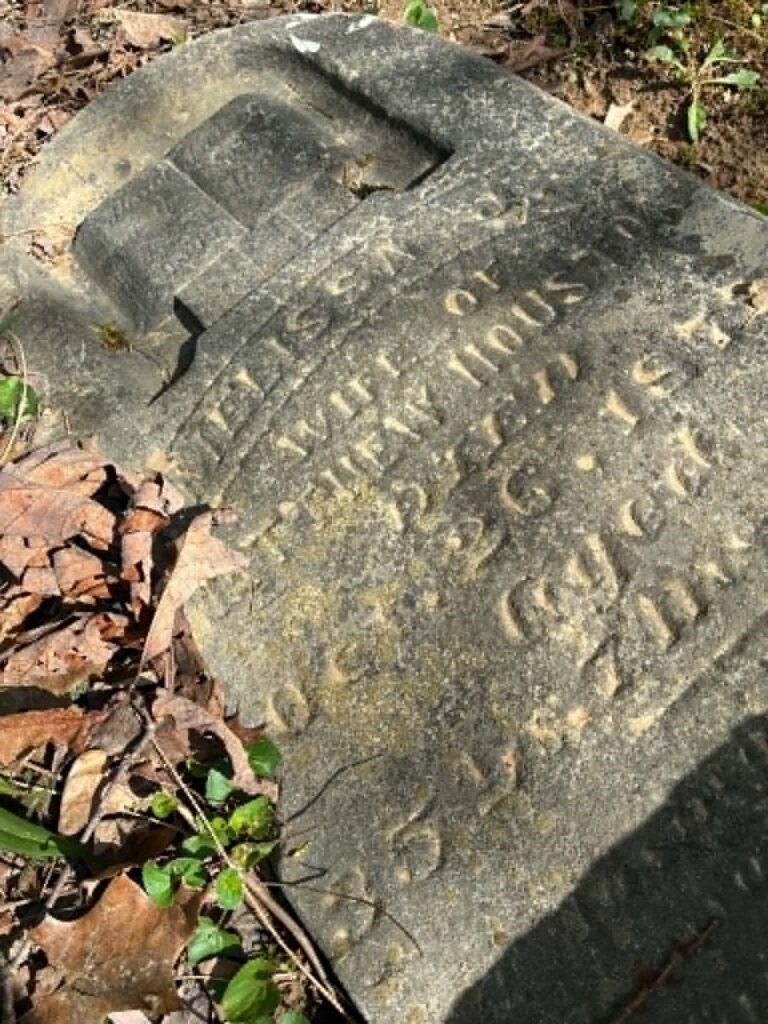
This act of serendipity revealed the identity of whom the grave belonged to. It belonged to Melissa J. Houston. The “ssa” I made out was correct, and as I had suspected, she was the oldest Gootherman daughter, Melissa. She was the oldest of the 12 children; she died October 26th, 1877, when she was sadly just 35 years old. I had no idea she died, and the cemetery book in the library didn’t list her with the Goothermans because the names were in alphabetical order. This added a whole new dimension to the extreme loss this family had endured. The loss of not two, but three daughters—including their very firstborn. The timing felt uncanny too. She died in 1877, and by 1880 Anderson was living with the Ruble family. I could hardly see this as a coincidence.
The tombstone called her the wife of Matthew Houston. I also know via Catharine’s will that Melissa and Matthew had a daughter, Verna. When I searched Verna in the census records, I found that she was born in August 1877, just two months before her mother passed away. Given how close Verna’s birth was to Melissa’s death, I thought that maybe there’s a connection. Maybe the death was due to complications from birth. I speculated at first it might be something like childbed fever, the result of infection of the reproductive tract. I searched through newspapers again, and I had a rare stroke of luck. I found her obituary. The newspaper said that she had a heart attack and was pronounced dead just twenty minutes later. While I was wrong about her cause of death, I do believe her death being caused by pregnancy-related complications is still very possible. For women over 35, studies show an increased probability of postpartum heart attacks. I strongly began to believe this played a role in the divorce.
After this, I refocused on my biggest goal: to find out the cause of death for all members of Eliza’s family. Record keeping in the late 19th century was unsurprisingly very spotty. In 1867, Ohio passed a law requiring probate courts to keep records of births and deaths. When I read this, I was disappointed because it ruled out a detailed record for Nancy. She passed in the summer of the year prior to the law being passed. However, it gave me hope I could find out how Anderson and Catharine passed in 1885. I, with great hopes and anxiety, called the county probate court. They asked me the year of the deaths I was looking for, and I told them “1885.” In reply, a woman said, “I’m sorry, our records only go to 1887.” My heart felt as deflated as a flat tire being shredded to pieces along the road.
The absurdity of being so close to having the answers I was looking for right in front of me. It’s like drowning at sea in the shallow part of the water before you get to land. I said thank you and hung up. I thought of giving up, but I took a deep breath. I had hit dead ends before, so I knew the only way out was to push through. I then switched gears and decided if I couldn’t find death records, maybe I could find a different puzzle piece. I called the clerk of courts and talked to a seemingly disinterested lady. I asked if they had divorce records, and if so, how far back they go. She paused. “Well…..those go pretty far back.” I asked, “Is there a policy that would allow me to look through the records?” She put me on hold for a few minutes. Finally, she said that it was too late in the day, but I could do it tomorrow. I thanked her for her time and had my trip planned.
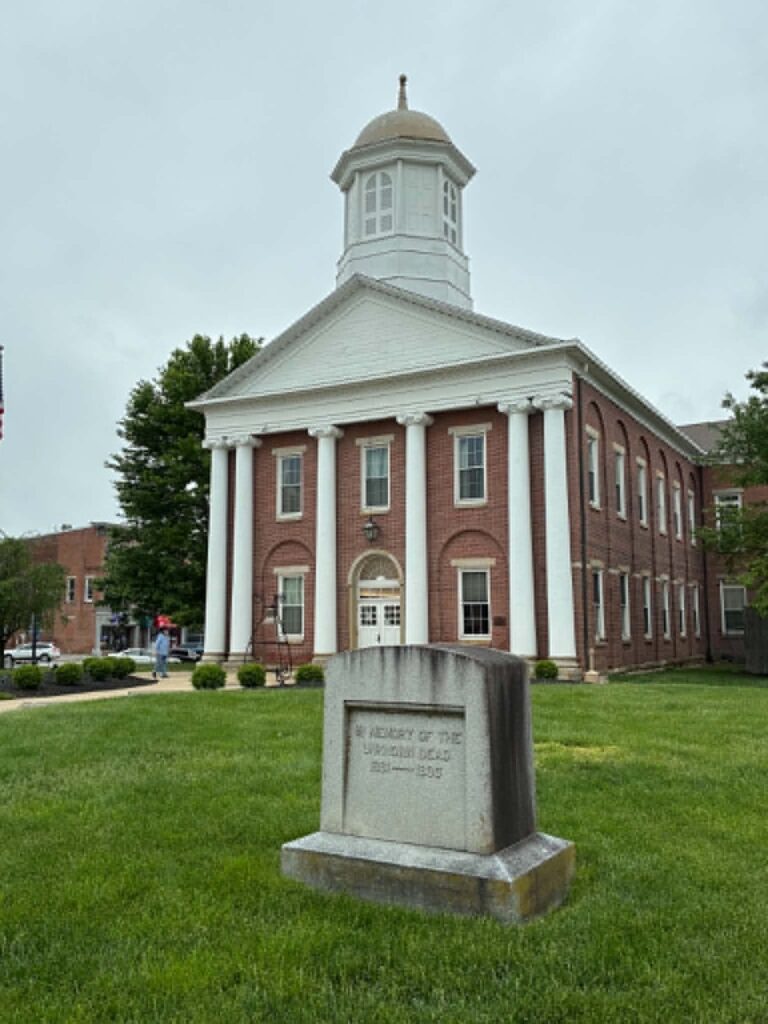
Around 11 am the next day, I put on my white fedora and drove to the Highland County courthouse. It was a short twenty-minute drive. I routinely pass it every day on my way to work. The courthouse itself was built in 1832, making it the oldest courthouse in Ohio. At the front of the courthouse, there was a soldier’s statue honouring the dead of the Union army. In front rested a rusted, battle-worn cannon. The building was made of brick with a golden dome touching against the sky, as if it were to signify divine justice itself. The entrance was aligned with Greek-style columns. I walked inside and wandered around a bit until I came to the office.
There was an elderly man passionately arguing with a lady by the office window. I don’t remember over what, but he seemed too stubborn to admit he was wrong, and it seemed obvious he was in the wrong. After he left, I approached the window with a notebook in one hand and a pen in the other. I had prepared to spend the next several hours searching records until I found the Gootherman’s. Through the window, I saw a few women in the office and a man named Ike, who was the clerk of courts. They asked me what I needed, and I smiled and told them. The next part surprised me. A lady smiled and walked towards me holding the Gootherman’s divorce records. She handed over the papers to me and said, “Be careful, those are very old.” I could tell from her voice that she was the lady who seemed disinterested on the phone. Yet for me she went above and beyond, showing great care.
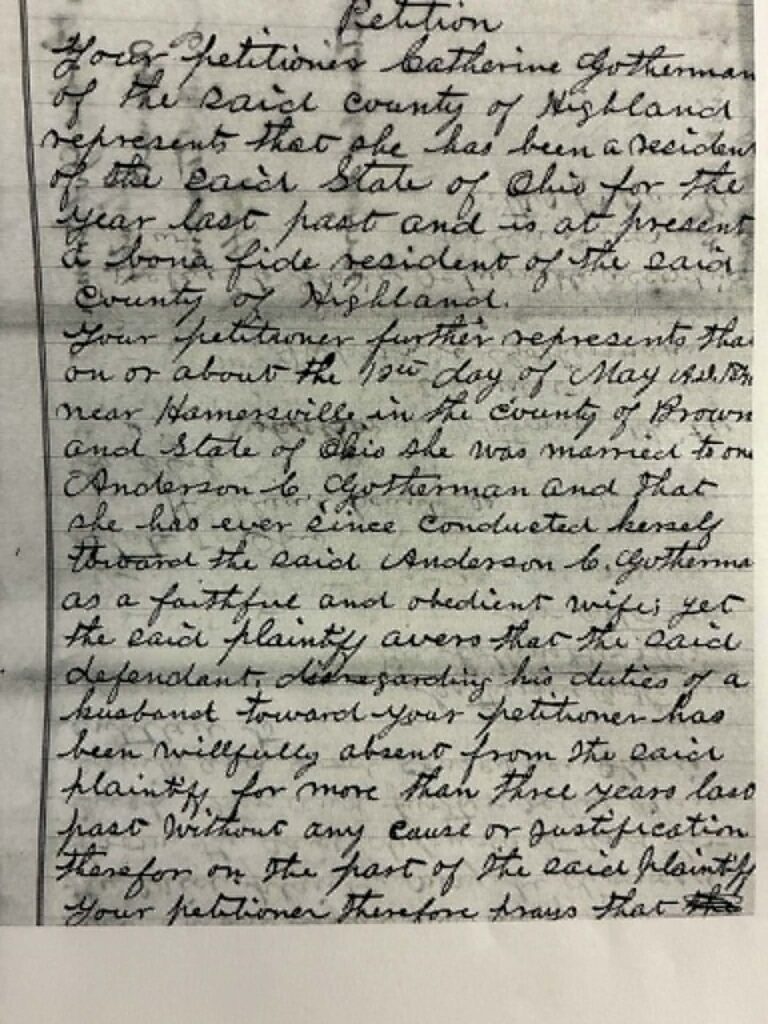
The papers were all scrawled in cursive, written in pencil, gently faded by time. They were light as a feather, but weighed down by heartbreak. Ike said to me, “If you want, we can make you copies of these so you can take them home.” I said “yes please” and handed the papers back. After a couple of minutes, they handed the copies over to me. Copies that to this day rest on my desk next to where I’m typing this out. I walked out to my car with a handful of papers, eagerly anticipating reading them. I got into my car parked along the street. I couldn’t wait to get home, so I sat and began scanning them. The papers, much like the mortality schedule earlier, were written in cursive and a little hard to make out. Luckily, though, I had read enough old documents at that point to make out the important parts.
The first paper at the top was titled “Case 3401. Plaintiff Catharine Gotherman against defendant Anderson Gotherman.” After being married for forty years, and after having twelve children, after losing three daughters, it all proved to be too much. She filed for divorce in August of 1881. I found what I was looking for. Toward the bottom of the page, the cause of the divorce was revealed to me. He was “willfully absent”; the grounds were abandonment. It said that he had been gone from Catharine and their children for over three years. The papers also revealed Anderson didn’t show up to court. I have a copy that was hand-delivered by the Highland County Sheriff himself. There’s no doubt he got the papers; he simply refused to even show up. The divorce was granted by default. His refusal to attend was seen as a confession of guilt. The simple math shows 1881 minus 3 would be around 1878. Very shortly after Melissa died, Anderson left his family. I see her death now as the catalyst—the event that led to him being with the Rubles in 1880. The event that divided the family, and now that division is physically manifested in their tombstones 140 years later.
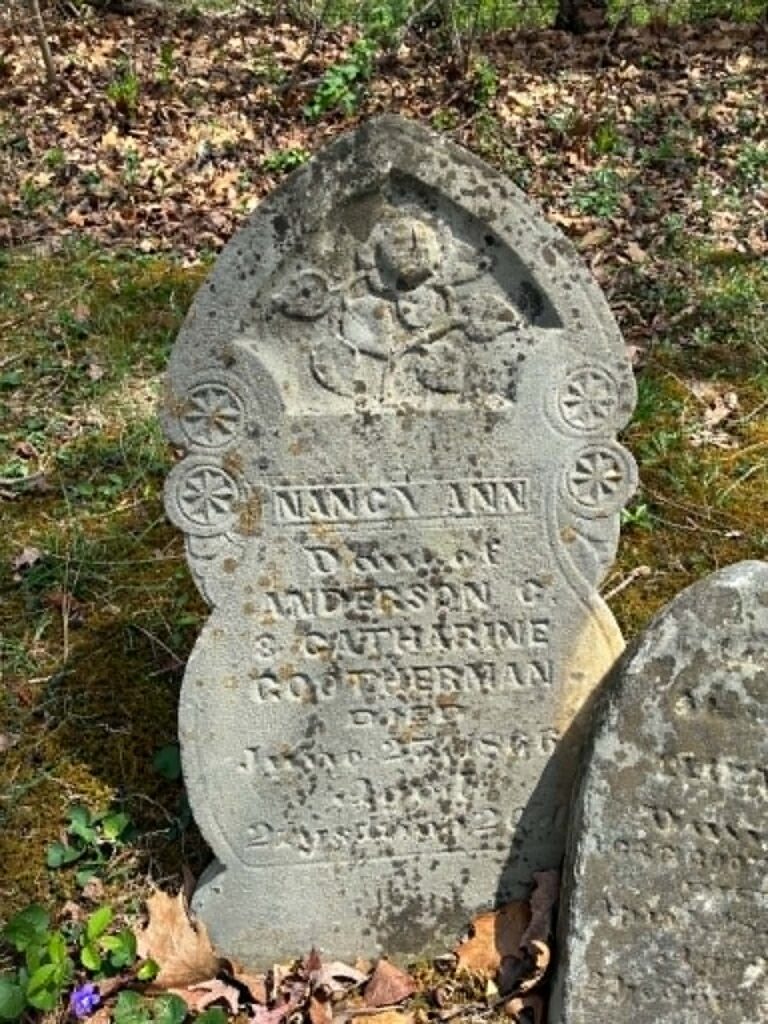
Once I felt I solved the mystery of Melissa’s death and how it caused the Gootherman divorce, I started looking into Nancy. Nancy died June 25, 1866, when she was only 21. I remember standing at her grave; hers had a rose carved at the top. I knew that death records, as we previously went over, only started the year after she died. I was left wondering how a young woman could be cut down in the prime of her life before she got married or had children. What could’ve taken her long before her time? I knew it could be a tall order, but as I read through a book on the history of Concord Township, I stumbled onto a little golden nugget of truth. There was a section that specifically went over the Miller’s Chapel area and the history of the prolific family that built the church.
It stated that in 1867, members of the Miller family had died during an outbreak of cholera that year—Phebe and her husband James G. Miller. Phebe on January 2nd and James on February 6th. Later in October, their relative Alonzo Miller also passed away. This gave me evidence of a localized outbreak within six months of Nancy’s passing. Also, summertime sees a spike in cholera cases because warmer water lets bacteria multiply faster. Nancy dying in the summertime added to my theory further. The evidence began stacking, and my theory started to cement. On top of that, I had found that 1866 saw a severe outbreak of cholera across the country, especially in the Ohio Valley. Cincinnati itself was heavily affected, seeing over 1,000 deaths. It’s roughly an hour and a half from Millers Chapel.
The puzzle pieces began to fit into place, and honestly, I started to get a little too impressed by my cleverness. Sadly, the harshness of historical research gave me a humbling smack in the face. I started reading old newspapers to understand the outbreak further. Early papers mentioned the US steamship Virginia and how it brought cholera over from Europe. Through railroads and through the Ohio River, it wouldn’t have taken long for cholera to spread. I tracked down a paper that set me back. It stated the very first death in Cincinnati was recorded July 12th. This, of course, complicates things because it would’ve been three weeks after Nancy died, and a disease like this often starts in highly populated cities and spreads outward to rural communities later. So how could she have died from it before it spread? She couldn’t have, and my theory took a critical hit.
My theory took another hit as I reread the book containing the deaths of the Millers. Upon rereading it, I caught an important, although seemingly pedantic, problem with the wording. It technically never said they died of cholera. It says they died during an outbreak. While it’s easy to read it as I first did, meaning they died because of it, it’s entirely possible the authors didn’t know the causes of death, but knew their deaths fell chronologically during the outbreak. Due to this, the proof of a localized outbreak is weaker. I tried searching for obituaries for any and all of the Millers. Despite my best efforts, no mentions or death records were found.
My once seemingly strong cumulative case for the cholera theory began to crumble. I was incredibly frustrated. I had a solid research method that served me well so far. I felt this time I may have fallen short. The honest answer is there’s no way to know with strong certainty how Nancy passed away. Despite the fact that my theory isn’t as well supported as I first thought, it’s still a possibility. While the first reported death in Cincinnati was July 12th, that simply tells us it was the first reported death. At this time, germ theory wasn’t fully accepted and understood yet. Due to this, cholera was a huge social stigma. Rather than realizing contaminated water and infrastructure issues caused it, people were seen as lazy and unclean. This may have led to doctors and families not being forthright with the actual causes of death initially.
Historians note that newspapers would often underreport outbreaks in their own city while focusing on outbreaks in distant cities. The reason for this was to prevent public panic and to avoid trade disruption and economic upheaval. Doctor John Bobbs, a doctor in Indiana during the 1849 outbreak, once said: “Our citizens generally discredited the first reports of cholera, and up to the middle of August, its prevalence continued to be questioned. Even at present many can be found who deny that we ever had cholera here; but it is among those who never believe until they see themselves, and they will never see the cholera, unless it steps into their own dwellings.” However, he noted that some inexperienced people would “label everything cholera.” However, historians like Charles Rosenberg, a historian who wrote “The Cholera Years,” note that underreporting of cholera was common due to misdiagnosing it as dysentery, diarrhea, or cholera infantum. Again, I can’t say for a certainty—cholera is simply the best explanation based on my limited data. Sometimes all we can do is trust the process and be honest with where it leads. I know if nothing else, I tried very hard to honor Nancy’s memory.
Finally, for the causes of death, we turn to the parents of the Gootherman family. I tried through the courthouse call to find death records, just to come up two years short. I searched unrelentingly for obituaries in newspapers. Between the two parents, I wouldn’t be shocked if I spent over a dozen hours searching, ultimately to no avail. For Anderson and Catharine, I have even less to go off of than the other family members. I know that Catharine passed away first, followed by Anderson exactly two weeks later. When I first read this, I thought it was heartbreaking. Although I have no data to say it, I still think that, despite leaving her and abandoning his family, I do believe the grief had to be immense. Nearly forty years of marriage. Twelve children, burying three.
In the absence of hard evidence, the only thing I can do is create a weak hypothesis based on the little I know. February being in the midst of winter caught my attention. Local newspapers mentioned temperatures in nearby towns reaching well below zero into the negative teens. That’s more than enough to kill an elderly person. Even if not directly through hypothermia, it could have potentially exacerbated underlying health issues such as pneumonia or influenza. I also found a newspaper dated to the day Anderson died mentioning the death of a Samuel Hibben. It lamented that many prominent elderly citizens had died that winter. I regret not being able to find more, but that’s my best assessment.
The last part of my journey, after having been to Millers Chapel Cemetery a couple of times, was to visit Anderson. I wasn’t sure at first if I would even go. I’m not sure if it was due to him leaving his family or the general unease I felt visiting graves. I made the choice that seeing him was the only way to conclude the story. Anderson is buried in Union Cemetery in Taylorsville, Ohio. I made a mistake and went to the wrong graveyard at first. I pulled my car into a church parking lot. The church was atop a hill, and its paint was a faded white. It looked old and dilapidated, albeit in a charming way. I walked down the gently sloped hill and past graves. I had seen the picture online and recognized I was at the wrong place. As I was pulling out, another car was waiting to pull in. This made me very uneasy and glad I chose to leave.
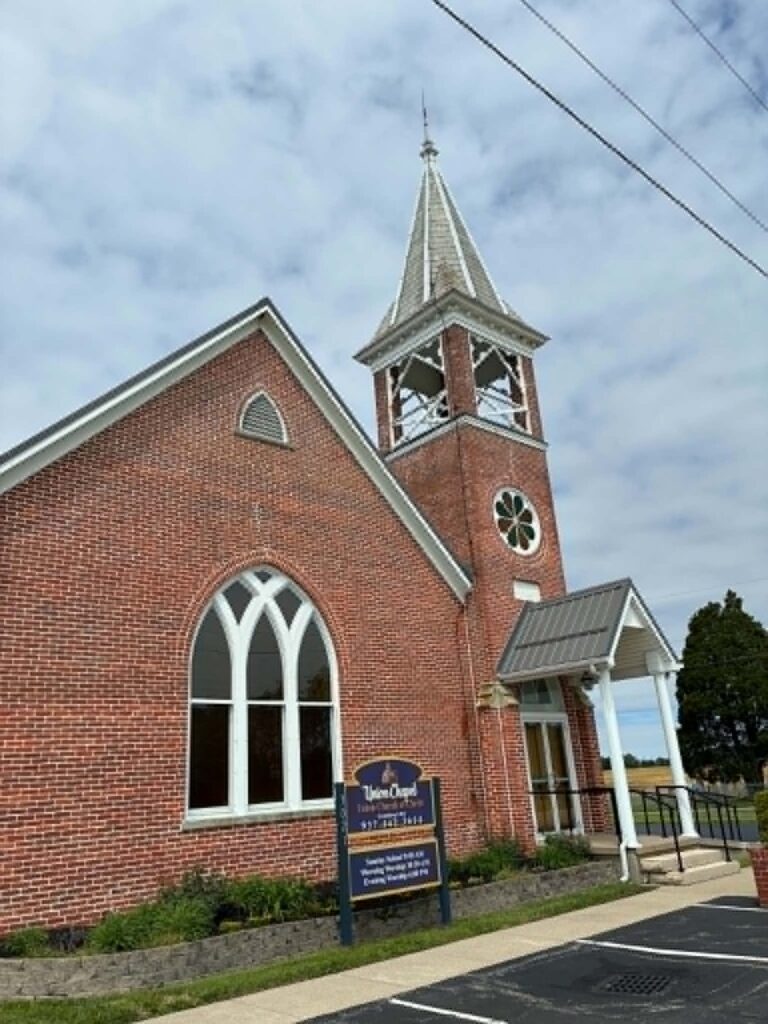
The misstep made me a little stressed, so I went home, choosing to delay the visit. The next day I had my GPS dialed in and made it safely. The church was modern-looking based on the bricks, but structurally it looked very gothic. It had a spire atop the church, much like a medieval castle. The windows looked like a cathedral with multicolored stained glass windows. They shimmered like a treasure trove of gems against the summer sun. I noticed, however, a black pickup truck parked in the lot. This understandably made me a bit nervous from my last adventure. I looked across the street, and a short walk away was the graveyard. The cemetery had a gated entrance; I pushed it and then noticed it was zip-tied.
It gave me the feeling I wasn’t supposed to be there, and from a distance, the black pickup truck loomed ominously. I noticed in the front row a set of names that were familiar to me: Catharine and George Ruble. Out of the hundreds of graves, theirs was in the very front row. They had two very large headstones with their names written on them and markers on the ground as well. I saw from the back that there was no fence at the end of the cemetery. I made my way to the very back, and it was at the very end that I found Anderson. There were no graves behind him or beside him to his left. Of course, there could be logistical reasons, but it almost felt like he was an outcast, while the Rubles had the permanent VIP treatment.
Moss wrapped his grave up like a blanket. The top had blackened like a cancer spreading slowly, obscuring his very name. It stood in stark contrast to the beautiful grave left behind for Catharine. To my surprise, though, he wasn’t left alone. To his right was his son, his oldest son James. James, who was named after Anderson’s father, passed away in 1919. His grave was a sharp contrast to his father’s. It gleamed against the sun, made of polished marble. It made me wonder if this signified the forgiveness James gave to his father later in life, or maybe, being the oldest son, he stayed close to his father. Oddly, Anderson’s grave faced in the opposite direction of the other graves.
I stood in front of him—the man who had lost three daughters: little Eliza, Nancy, and finally Melissa. The man who left his family when they needed him. Many would see him as the villain of this story. I can’t lie and say I’d blame you. I got down on my knees and placed my hand on top of his headstone. I told him that I would make sure his story was told: the story of his wife and children, their love and their loss. I told him I understand that he didn’t have the tools to deal with the level of grief and loss he had.
Men in those times were taught to suppress their feelings and be stoic golems. They weren’t equipped to deal with what depth psychologist Carl Jung would call the shadow self. I wouldn’t say it was my place to give forgiveness to him, but I gave him my understanding. I told him to rest peacefully. I stood up with grass stains on my pants and slowly walked back to my car, watching as the graves faded into the distance. With that, the research was done. After two months of reading censuses, of reading mortality schedules and wills, of visiting graveyards and going to old courthouses, the adventure was over.
When I started this journey, I felt like the Goothermans needed me—like I had a duty to rescue them from being lost to time. I see now that wasn’t true. If anything, I needed them. I’m thankful for this adventure they gave me: the research, the theories, the trips to graves and courthouses; the highs of making discoveries and validating theories; the lows of dead ends. What an incredible journey this has been. I realize now the names on our graves will all fade away. They will all fall over, breaking into pieces. Even our memories will be forgotten. I see now this is ok. None of us can have a permanent impact on the world, but we can leave a mark on those we loved when we are here. I’m honored to have the privilege of sharing their story and hope that in doing so, their flame will burn a little longer. In the end, I do not know what I saw as a little boy—if it was Eliza’s ghost or a dream. I just know the story she led me to was so much more phenomenal.
This account is based on primary source research conducted between March and July 2026, including county probate and divorce records, federal census and mortality schedule data, contemporary newspaper archives, and on-site cemetery documentation in Highland County, Ohio. Some causes of death (particularly for Nancy, Anderson, and Catharine Gootherman) could not be conclusively documented and are presented as historically-grounded hypotheses rather than established fact, as noted in the text.
Bibliography
Bibliography — Find a Grave
Find a Grave. “Millers Chapel Cemetery.” Accessed August 2026. https://www.findagrave.com/cemetery/42152/millers-chapel-cemetery.
Find a Grave. “Eliza Gootherman.” Accessed August 2026 https://www.findagrave.com/memorial/46458331/eliza-o-gootherman
Find a Grave. “Nancy Ann Gootherman.” Accessed August 2026. https://www.findagrave.com/memorial/46458180/nancy_ann-gootherman.
Find a Grave. “Melissa J. (Gootherman) Houston.” Accessed August 2026. https://www.findagrave.com/memorial/46459340/melissa-j-houston.
Find a Grave. “Catharine Gotherman.” Accessed August 2026. https://www.findagrave.com/memorial/46458075/catharine-gotherman.
Find a Grave. “Anderson C. Gotherman.” Accessed August 2026. https://www.findagrave.com/memorial/104151887/anderson_c-gotherman.
Newspapers
The Highland Weekly News (Hillsborough [Hillsboro], Highland County, Ohio). May 3, 1860. Chronicling America: Historic American Newspapers, Library of Congress. https://www.loc.gov/item/sn85038158/1860-05-03/ed-1/.
The Highland Weekly News (Hillsborough [Hillsboro], Highland County, Ohio). February 25, 1885. Chronicling America: Historic American Newspapers, Library of Congress. https://www.loc.gov/item/sn85038158/1885-02-25/ed-1/.
The Highland Weekly News (Hillsborough [Hillsboro], Highland County, Ohio). November 1877 [obituary of Melissa J. Houston]. Chronicling America: Historic American Newspapers, Library of Congress. https://chroniclingamerica.loc.gov/lccn/sn85038158/.
The Highland Weekly News (Hillsborough [Hillsboro], Highland County, Ohio). July 1866 [reporting on the Ohio Valley/Cincinnati cholera outbreak]. Chronicling America: Historic American Newspapers, Library of Congress. https://chroniclingamerica.loc.gov/lccn/sn85038158/.
Census & Government Records
U.S. Federal Census (Mortality Schedule). Highland County, Ohio, 1860. Ancestry.com.
U.S. Federal Census (Agricultural Schedule). Highland County, Ohio, 1870. Ancestry.com.
U.S. Federal Census (Population Schedule). Highland County, Ohio, 1870. Ancestry.com.
U.S. Federal Census (Population Schedule). Highland County, Ohio, 1880. Ancestry.com.
Catharine Gootherman. Last Will and Testament. Highland County Probate Court. Accessed via Ancestry.com.
Catharine Gootherman v. Anderson Gootherman, Case No. 3401. Highland County Court of Common Pleas (filed August 1881). Highland County Clerk of Courts, Hillsboro, Ohio. Copy in author’s possession.
Local History
Ayres, Elsie Johnson. Highland Pioneer Sketches and Family Genealogies. Excerpt on Miller Chapel and the Miller family reproduced at “Highland — Pioneer Sketches,” Bishir Family Scrapbook, accessed August 2026. https://www.bishir.org/misc/millersketches.pdf.
Secondary Sources
Rosenberg, Charles E. The Cholera Years: The United States in 1832, 1849, and 1866. Chicago: University of Chicago Press, 1987.
“A Direful Scourge: The 1849 Cholera Epidemic in Indianapolis.” Class 900 Indy, March 22, 2020. https://www.class900indy.com/post/a-direful-scourge-the-1849-cholera-epidemic-in-indianapolis. (Source of the John Bobbs quotation used in the text — Bobbs is quoted secondhand via this article, not from his original 1853 report to the Indiana Medical Society.)
Newspapers
The Highland Weekly News (Hillsborough [Hillsboro], Highland County, Ohio). May 3, 1860. Chronicling America: Historic American Newspapers, Library of Congress. https://www.loc.gov/item/sn85038158/1860-05-03/ed-1/.
The Highland Weekly News (Hillsborough [Hillsboro], Highland County, Ohio). February 25, 1885. Chronicling America: Historic American Newspapers, Library of Congress. https://www.loc.gov/item/sn85038158/1885-02-25/ed-1/.
The Highland Weekly News (Hillsborough [Hillsboro], Highland County, Ohio). November 1877 [obituary of Melissa J. Houston]. Chronicling America: Historic American Newspapers, Library of Congress. https://chroniclingamerica.loc.gov/lccn/sn85038158/.
The Highland Weekly News (Hillsborough [Hillsboro], Highland County, Ohio). July 1866 [reporting on the Ohio Valley/Cincinnati cholera outbreak]. Chronicling America: Historic American Newspapers, Library of Congress. https://chroniclingamerica.loc.gov/lccn/sn85038158/.
Local History
Ayres, Elsie Johnson. Highland Pioneer Sketches and Family Genealogies. Excerpt on Miller Chapel and the Miller family reproduced at “Highland — Pioneer Sketches,” Bishir Family Scrapbook, accessed August 2026. https://www.bishir.org/misc/millersketches.pdf.
Secondary Sources
Rosenberg, Charles E. The Cholera Years: The United States in 1832, 1849, and 1866. Chicago: University of Chicago Press, 1987.
“A Direful Scourge: The 1849 Cholera Epidemic in Indianapolis.” Class 900 Indy, March 22, 2020. https://www.class900indy.com/post/a-direful-scourge-the-1849-cholera-epidemic-in-indianapolis. (Source of the John Bobbs quotation used in the text — Bobbs is quoted secondhand via this article, not from his original 1853 report to the Indiana Medical Society.)